.svg)
What is a unified switch? The central nervous system of modern payments

Every financial institution has a moment when its payment stack reaches a breaking point. Maybe it happens during a seasonal surge. Maybe it happens when a new product goes live. Or when a partner rail goes down at the exact wrong time.
It often starts with a dashboard full of red alerts. Transactions time out. Payment costs spike. Reconciliation takes days instead of hours. Teams scramble across different systems trying to understand where the bottleneck is. Not because the institution lacks expertise. But because the infrastructure behind the scenes was never designed to scale together.
This is the moment many leaders discover why a unified switch matters.
The silent problem inside most payment stacks
Most institutions build their payment capabilities over many years. One integration at a time. One rail at a time. One workaround at a time.
The result is a payment architecture that works, but only with:
- Separate routing logic for each payment type
- Duplicate risk rules across systems
- Multiple vendor dashboards and reporting formats
- Point-to-point integrations that break easily
- Limited visibility across the full payment lifecycle
Individually, none of these issues seem critical. Together, they slow growth, introduce risk, and increase operational cost.
A unified switch is designed to solve exactly this.
What a unified switch actually is
A unified switch is the central payment engine that coordinates all incoming and outgoing transactions across every channel. Instead of treating cards, transfers, payouts, and digital wallets as separate systems, the switch brings everything into one flow. It does this by acting as the decision-maker for the entire payment stack.
Every transaction passes through the switch where it is checked, scored, validated, and routed to the right rail. The institution sets the rules. The switch enforces them consistently.
Why more institutions are moving toward unified switching
1. It creates a single source of truth
When all payment types travel through the same orchestration layer, teams finally gain a consolidated view of activity. The switch standardizes how data is captured, how risk is applied, and how logs are generated. This makes compliance easier and simplifies audits. It also makes product performance far more predictable.
2. It adapts to payment changes without major rewrites
Payment ecosystems evolve quickly. New instant payment networks. New domestic schemes. New cross border options. With a unified switch, institutions add these rails once and apply routing logic immediately.
3. It improves reliability through intelligent routing
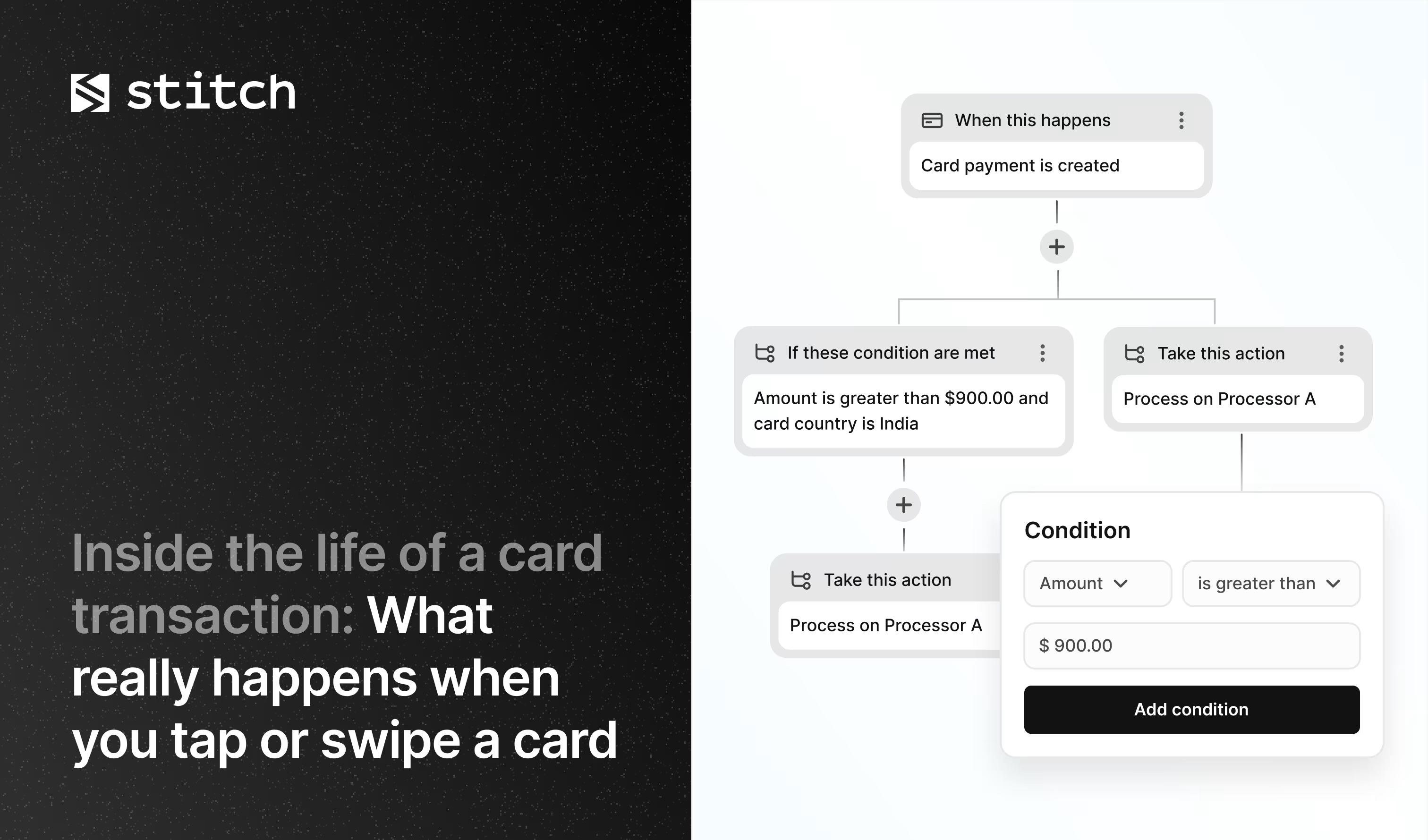
If a processor degrades, the switch can reroute traffic automatically to maintain availability. At the same time, it applies deterministic rules based on transaction type, such as card-present versus card-not-present flows. This keeps performance stable and behavior consistent regardless of external dependencies.
4. It accelerates the launch of new financial products
Institutions do not need a separate backend for each new product. The switch already handles core needs: authorization, routing, risk checks, ledger sync, and settlement instructions. Product teams focus on design and experience instead of rebuilding infrastructure.
What a unified switch looks like inside a modern financial institution
Inside a mature institution, the unified switch typically manages:
- Authorization decisions
- Network and rail routing
- Fraud and risk logic
- Tokenization and card controls
- Settlement rules
- Reversals, fallbacks, and retries
- Data normalization
- Real time ledger sync
The switch becomes the nerve center. All payment intelligence radiates from this one layer.
Why this matters for the next decade of finance
Payment volumes continue to rise. Real time rails are becoming standard. Customers expect instant settlement and predictable performance. Institutions cannot meet these expectations if their backend is fragmented.
A unified switch, like Stitch, gives them the structure, control, and reliability required to operate at scale. Financial institutions can operate cards, payments, deposits, and wallets with consistency and control. It gives teams a single orchestration layer for authorization, routing, risk, and ledgering across all payment types.
The result is simpler operations, faster product development, and a more resilient payment stack. The kind of foundation institutions need as finance becomes more real time, more connected, and more customer driven. It is not a nice-to-have. It is the foundation of modern payment architecture.